Sunday, September 7, 2014

Fort Knox

Quick trivia quiz.  Who was Major Hoolihan's husband on the television version of M*A*S*H?  If you said Donald Penobscot, give yourself 10 points.  As a Californian, I always assumed Penobscot was just a name they made up because it sounded funny but the fact is that this is not exactly true.  Penobscot is the name of an Indian tribe in Maine.  They picked the wrong side (i.e. the froggy side) in the French and Indian war and were relegated to obscurity and near extinction.  About 450 of them still live on a small reservation just north of Bangor.  Their main claim to modern fame is that they opened the first Indian gambling establishment, a high stakes BINGO parlor, back in 1973.  They also lent their tribal name to the Penobscot River.

The old Waldo-Hancock Bridge
At the mouth of the river is a narrows that made a convenient spot to build a bridge across to connect Waldo and Hancock counties between the town of Prospect and Verona Island.  So, in 1931 they built the Waldo-Hancock bridge across the narrows.  It used some new construction techniques, like pre-fabricated, pre-stressed cables and something called a  Vierendeel truss that were  used a few years later in another little project called the Golden Gate Bridge.   But the most significant thing about the Waldo-Hancock bridge was that it came in way under budget and they were able to use the leftover money to build a second bridge from Verona Island to Bucksport, completely eliminating the need for the Prospect Ferry.

The Waldo-Hancock bridge served faithfully for 70 some odd years, but by the start of the new millennia was showing its age and a major project was undertaken to rehabilitate it.  In the process however, they discovered it had more problems than they had realized and could not be satisfactorily repaired.  So they spent about 20 times the original cost of the bridge to do some temporary strengthening, then got to work on a new bridge about 10 feet to the south.

Penobscot Narrows Bridge from the east...
The Penobscot Narrows Bridge was completed in 2006 and we had to drive across it to get from Boothbay to Acadia NP, but it was a hazy, yuk day and stopping the motorhome for pictures and sightseeing is usually a pain in the butt, so we drove on, then picked a nice sunny day and drove back to it in the car later in the week.  The new bridge has some innovative engineering stuff of its own to brag about, but I'm not enough of an engineer to have understood most of it.  Some of what I did understand is that the cables are all encased in steel tubes filled with pressurized nitrogen gas to help prevent corrosion.  And 6 of the cables were made of experimental carbon fiber which is being monitored to see how well it holds up for possible use in future bridges.
... and from the west
It is a striking looking bridge and has one additional feature that makes it definitely worth a visit.  They installed an observation area in the west tower giving fantastic views of Bucksport and the Penobscot River.  It is the tallest bridge observatory in the world, reaching 420 feet, and you get to it via the fastest elevator in Maine.  Vicki, you may recall, is not too keen on heights, so I took the elevator ride up alone and snapped a few pics for your edification.

Bucksport from the observatory

View across the bridge from the tower - you can see the pylon from the old bridge which was demolished in 2013

Fort Knox entrance
For the same reason this was a good place to build a bridge, it was also a good spot from which to defend the river.  The  British navy had sailed up the Penobscot in both the Revolutionary War and the War of 1812 in order to bombard Bangor and whatever else in the area seemed bombardable.  In order to prevent future recurrences of this, the young US decided to install a granite fort at the narrows which we also visited while we were there.  This is Fort Knox (no not the one Goldfinger broke into, that's in Kentucky).  Both Ft. Knoxes were named after Henry Knox, the first US secretary of war, who retired nearby in Thomaston.

View of the fort from the bridge tower
Construction began in 1844 but because the US was mostly broke most of the time and they were trying to build similar fortifications on every major river along the east coast, funding was inadequate and construction sporadic.  The fort was nearly complete in 1869 but by then it was already obsolete.  It never defended the river, never fired a shot in anger and was never garrisoned until the Spanish American war when a regiment from Conneticut was supposed to be stationed there for a few months.  Since the enlisted quarters had never been completed, a few officers stayed in the officers quarter while most of the regiment camped in tents a half mile away.  When
10 inch gun threw a 100 lb. ball up to 2 miles
that war ended, the garrison was reduced to a single man, "the keeper of the fort" and that's how the situation remained until 1929 when the feds declared the fort "excess" and sold it to the state of Maine for a couple grand.  On the bright side, the fort never suffered much wear and tear so it's in remarkably good shape and makes for a pleasant afternoon's exploration.

As for Hotlips' fictional hubby, I don't think Penobscot was ever actually used as a family name in real life.  The Maine phone directory shows no one named Penobscot and extending the search to New York and Massachusetts still comes up with zilch.  So my original speculation still stands. They just used the name because the writers thought it sounded funny.  After all, the writers were all Californians too.
Civil War era medical transport
Parade ground inside Fort Knox


Last winter we spent three months working on the Navajo reservation in Arizona.  After a few months to sort through her feelings about it, Vicki has written up her impressions of the experience which we will be including in segments over the next few posts 

Working in Chinle
By Vicki Rains


Chinle healthcare facility
The hospital and clinic in Chinle, built in about 1982, is a fairly nice facility.  It has separate Internal Medicine and Family Practice clinics, but in fact they are really one ambulatory care clinic.  They are staffed with doctors and nurse practitioners with Navajo “health techs” covering the jobs that Roger’s office staff did in CA.  All the doctors and nurse practitioners were from elsewhere in the country.  None were Navajo.  Almost all the health techs were Navajo. 
 

The visits were 20 minutes each, which was fine for straight forward ambulatory patients and follow ups but for patients who were new to us and had multiple medical problems it was difficult.  The reason is the computer program.  It was not a terribly bad program but nobody bothered to orient us on it.  We got about a ½ hour video on it and that was it.  Fortunately we both are pretty computer literate but at the beginning we were constantly having to ask a doctor or NP how to do something.  Since they hadn’t been trained any better, they didn’t always know the answers.  When we went looking for someone, they weren’t always available so we had to wait.  Even after 3 months there were still things we didn’t know how to do. 
 

Window Rock
We worked from 8 AM to noon and then from 1 PM to 5 PM.  We weren’t supposed to do overtime.  We didn’t always finish on time but on Thursday mornings we had administrative time which we didn’t need all of so it usually balanced out pretty fairly.  Roger covered call, I think twice, and for that he made $ 5 more an hour than I did, but I haven’t worked in a hospital for over 5 years so I wasn’t interested in it and they weren’t interested in me covering it.  We had weekends off.  

A day trip to Monument Valley
Most people took off for the weekend.  We often left for a day trip but we don’t like to travel any more than 90 miles one way in a day trip so we didn't go to places like the Grand Canyon.  However, we have previously been at least once, and often twice, to every tourist destination around Chinle.  We did stop at the Grand Canyon on our way back to CA.
 

One of my challenges while working in Chinle was to see if I could still work as a general internist.  I started my geriatric fellowship in 1987 and haven’t done pure internal medicine in a clinic since then.  I am happy to say that my skills came back readily.  The drug formulary, in order to have reduced costs, consisted mostly of generic drugs I prescribed way back when.  Yes, I succeeded, but I didn’t really like it.  I remembered why I went into geriatrics and then into hospice and palliative care.  

Before we left for Chinle I interviewed for a job with Vitas Hospice.  Yes, it’s the company I used to work for.  Fortunately, the general manager that I despised had left.  I started working for Vitas again when I got back to California from Chinle.  The job I have now is part of what I used to have to do 2 years ago before I quit.  I can do it anywhere in the country as long as I have access to a phone and internet.  It takes me about an hour a day.  When I am in SoCal I can potentially do patient visits and cover team meetings.  This way I can keep my hospice skills intact.
 

Spider Rock in Canyon de Chelly right next to Chinle
So would I do it again?  Well, obviously not at the moment since I am working for Vitas again but neither one of us will likely ever want to go back to Chinle.  Yes, there were a lot of negatives and few positives but the prevailing negative was the fact that the doctors that we worked with were not very friendly.  They were nice when they answered our questions, but other than that they mostly ignored us.  I doubt anyone knew we are full time RV’ers because nobody asked anything about us.  There was nothing social offered to us.  They even had a journal club and didn’t ask if we would like to come.  So we felt pretty isolated.

Thursday, August 28, 2014

The Lobster Cruise


Not all of Mount Desert Island belongs to the federal government. Acadia National Park takes up only about two thirds of the island, the rest remains private property. The gazillion tourists crowding in to see the National Park are much less interested in the little villages and homes that constitute the remainder.

At the south-west tip of the island is Bass Harbor, a well protected inlet where the island's fishermen keep many of their boats moored. On the west side of the harbor is the small fishing community of Bernard, the home of Thurston's Lobster Pound. We visited Thurston's for lunch one day while touring the area and had some BLT sandwiches. That's bacon, lobster and tomato (oh yeah, and a little leaf of lettuce). It's kind of like a lobster roll with a couple of slices of regular bread instead of the roll. The bread is pan toasted then onto it goes 3 pieces of thick sliced bacon followed by a healthy serving of lobster salad (at least as much as
Thurston's Lobster Pound
you'd see in most lobster rolls) topped by the lettuce and tomato slices.  It was a great combination and not one that we have seen offered anywhere else, which is kind of surprising.  These can't be the only folks who have figured out that everything is better with bacon.  Add chips and a local brew and you have a nearly perfect lunch.  The view out from the picnic table dining area was of a typical New England fishing village, quite peaceful and idyllic.  A pleasant change from Bar Harbor.
Typical fishing village
The town of Bass Harbor is on the opposite side of the inlet and after lunch we drove over there to take a short cruise around some of the smaller islands in the area and learn a little about the lobster business.
Bass Harbor
This is Captain Jim, our boat driver and tour guide.  He may not be able to do cubed roots or quote Chaucer but he seems to have an astounding grasp of everything there is to know about local history, the fishing economy, coastal wildlife and hauling lobsters.  According to Capt. Jim, when you talk about fishing in Down East Maine, you are talking about lobstering.  This was not always the case.  The early Maine economy was based largely on codfish.  There are captain's logs from the 18th century describing ships under full sail being brought to a complete stop by the sheer density of the schools of cod swimming in the Gulf of Maine.
Bass Harbor Light
The earliest settlers in this area came partly to harvest the timber and granite as building materials for the great east coast cities in the days before concrete buildings, but mostly they came for the cod.  This continued for a couple of centuries with no end in site and seemed to be a limitless resource.  Salted cod was shipped from Maine to the entire world.  But then in the last half of the 20th century the giant factory ships arrived.  Huge trawlers from all over the globe came here back in the days of the 3 mile territorial limit.  By the 1990s,cod had been badly over-fished.  When the yearly catch dropped to almost nothing they started placing controls on the catch, but so far the cod numbers have not rebounded and there are reasons to think they never will, at least not in our lifetimes.

In the meantime lobster, which was traditionally relegated to feeding the poor and prison inmates, had become a luxury item on city menus and Maine fishermen switched gears.  The lobster fishery, along with clams and mussels, is now essentially the only one left in Maine.

Remnant of an island village
The early fishermen initially settled almost exclusively on the numerous small islands that dot the Maine coast, which seems strange to us but made sense at the time.  There were almost no roads, the dense forests were almost impassible, so all of their trading and supply lines were maintained by boat anyway.  And if you are on an island 2 or 3 miles from the mainland you start your day every morning 2 or 3 miles closer to the fish.  Since most of the 18th century fishing boats were powered by the fishermen, this could make a huge difference in your day.

Pleasure boaters among the islands
Later on when the boats were steam or diesel powered and a couple of miles of ocean was less of a big deal, people gradually moved to the mainland, creating the numerous small fishing villages that are now a hallmark of the state.  Many of the smaller islands have been completely abandoned and have been turned into wildlife sanctuaries.  The rocky shorelines make a pleasant home for harbor seals as well as their much larger cousins, the grey seals.  The islands also support all of the bird species we saw on our puffin tour a couple of weeks back.  There are numerous white tail deer and even the occasional moose.  And the bald eagle, which had nearly disappeared from this area, is making a strong comeback.  We saw one on Hancock Island during our tour.  I tried to get some pics but with only marginal success.  If you want good eagle photos you'll have to go back to our visit to Minnesota here.

Harbor seals sunning on the rocks

Grey seal

Bald eagle flies overhead


Lobster in the trap
Capt. Jim has his own lobstering operation and at the end of the tour he pulled a lobster trap for us so we could see the process.  Maine has tried to avoid having lobster go the way of the cod by instituting strict rules on what lobster can be brought to market.  They must fall into a limited size range.  Lobster that are too small must be thrown back to gain more weight.  Lobster that are large produce way more offspring per pound than the little guys which is good for the population, so they also must be thrown back.  Any female carrying eggs also gets a free pass. 
Measuring the catch

So in the trap we pulled there were 9 lobster of which 4 were legal and the rest went back into the water.  What happens to them?  Well, in the area we were in there are lobster traps about every 40 or 50 feet in all direction for miles. So the critters that are thrown back almost immediately find their way into another trap where they relax, party a little and eat the tons of herring bait placed in the traps, well protected from all of their major predators until the next time they get yanked out of the water.  Maine fishermen are only sort of in the business of catching lobster.  They are mostly in the business of feeding them.

The result of all of this is that despite record harvests over the last decade, there are now more lobster in the Gulf of Maine than there have ever been.  126,000,000 lbs. of lobster were landed in 2012, up 25% from 3 years before and 700% compared to the 1990s.  Unfortunately for the lobstermen, they have become victims of their own success.  At the peak of the season last year the price paid to the fisherman for lobster at the dock dropped from $4.00 per lb. to $1.35.  They are working harder to bring in more product and taking home less money for it.  Obviously some adjustments need to be made.

In the meantime, we continue to do what we can to help relieve the lobster glut.  At the motorhome park where we are currently staying, the owner keeps a refrigerated tank stocked with live lobster and for a very reasonable price he will boil them up and deliver them to your rig.  Vicki and I each had a 1.5 lb. crustacean for dinner.  Life is good.


Last winter we spent three months working on the Navajo reservation in Arizona.  After a few months to sort through her feelings about it, Vicki has written up her impressions of the experience which we will be including in segments over the next few posts 


Working in Chinle
By Vicki Rains


For three months this was home sweet home
The hospital at Chinle has four motorhome sites next to their building which were all filled with other temporary workers while we were there, but they had assured us they would make arrangement for us when we spoke to them back in December. When we arrived in Chinle they were still making arrangements.  They had a vacant lot about 4 miles from the hospital building they were setting up as additional camping sites.  As we pulled in we noticed that workers were still busily setting up the
water and electricity and finishing the grading. They pointed out where we should go but the dump receptacle would have been right under the rig. When we first arrive
Hookup were full, if a little spread out
at a campground Roger is the one who drives the rig and backs in and it is my job to give him directions and guide him in.  However, the worker was not happy that I did not want to go where he had pointed, so he insisted on talking to Roger.  I thought I better not cause a commotion before we even started working so I dutifully went and got Roger, who of course agreed that we weren't going to park on top of the sewer connection then crawl under the rig to hook up.  So we parked next to the dump hook-up, which put us about 15 feet from the water connection and 25 feet from the electricity.  As we were connecting, we discovered that the 50 amp outlet was upside down which was a problem for our surge protector.  Fortunately the person who set it up was still in the yard so he came and corrected its orientation.

So what was home for 3 months? A gravel covered lot with no attempt to make it habitable.  There were no plants, no decent view, etc.  We never put out our rug or chairs because the area was so ugly.  The only time we went outside was when we needed to leave or when I needed to take the dogs for a walk.

Tribal residential area
Chinle is an ugly town with a lot of derelict buildings.  Buildings that need repairs aren’t getting them.  It is either because the Navajo don’t care or because they don’t have the money.  I think the answer falls somewhere in the middle, but closer to the latter.  The Navajo reservation is the poorest Indian reservation in the country.  To quote our son Christopher, “Who knew a third world country was so close.”

There is no barber or beauty salon in Chinle, a town of about 5000 people.  Where did we get our hair cut?  I got my hair cut when I went back to California and let it grow otherwise.  For Roger we had to drive 90 miles to Gallop, NM, the closest barber and closest city.

As I mentioned in an earlier post, we were fortunate that we never got truly cold weather.  We had one slight sprinkling of an inch of snow that didn’t last and one significant rainstorm.  There was a fair amount of rain with the rainstorm and its consequence was to cause a sink hole about a foot deep and 5 feet in diameter where they had put in our water line.  Now we had a lake front property!


Dust storm
Dust Storms—When we were deciding whether to go to Chinle, we looked at climate charts and descriptions of the weather on the internet.  However, none of those websites mentioned the fierce winds that are almost constant starting a week or two into April and lasting for about a month.  The winds generally were about 20 to 30 miles an hour with gusts up to 50 to 60 miles an hour.  We were worried that the awnings over our slideouts would rip so we pulled them in whenever the winds really whipped up.  Since there is not much to do in Chinle on windy weekends we were stuck in our motorhome which was really cramped with the slides pulled in.  Fortunately we were just able to open up our recliners, though the foot rests touched the opposite wall, and use fairly passable internet for entertainment.  The recruiting company paid for the internet service for the 3 months we worked at Chinle.  

The building behind us is the residential drug and alcohol treatment center.  Just beyond that is the youth correctional facility.

Sunday, August 24, 2014

Acadia


Acadia National Park - nice enough I guess

In 1872, through an act of congress, Yellowstone became the first National Park in the United States, or the world for that matter.  The second was Mackinac Island in Michigan, but after a few years the good people of Michigan asked for that one back, so it was released from federal custody and is now a Michigan State Park, however other locations had been added to the list in the meantime.  Between 1872 and 1919 the National Park Service grew to include Yosemite, the Grand Canyon, Crater Lake, Mt. Ranier, Sequoia, Denali in Alaska, Haleakala in Hawaii, Wind Cave in the Black Hills, Rocky Mountain and Glacier National Parks, the Mesa Verde cliff dwellings and Mount Lassen in California.  Thirteen National Parks and they all had one thing in common.  They were all west of the Mississippi River.  Whereas the vast majority of US citizens were not.  And they were getting pretty fed up about it.
 

At the dawn of the 20th century, getting from New York or Boston to the Yosemite Valley was no simple matter.  Most people could not take a couple of weeks off to cross the country on a pleasure trip. They wanted something a little closer to home.
Bar Harbor from atop Cadillac Mountain
Mount Desert Island had been attracting artists and outdoorsmen since the mid-1800s and had been popularized in the newspapers of the time. This attracted the wealthy, the Rockefellers, Morgans, Fords, Vanderbilts,
Carnegies, and Astors, who came and built "cottages", which were actually luxurious mansions with dozens of rooms where the families could spend vacations in pseudo-rustic surroundings. One of these super-affluent vacationers, George B. Dorr, became obsessed with

Cruise ship at Bar Harbor
preserving the area and managed to get his family and friends to donate parcels of land, eventually acquiring about 6000 acres of Mount Desert Island which was then donated to the federal government so that in 1916 his buddy, Woodrow Wilson, could create the Sieur de Monts National Monument, which he was able to do with nobody's permission by presidential fiat. Creating a national park still required an act of Congress, which was finally arranged in 1919 with the creation of Lafayette National Park. Bit by bit, more acreage was added and the name was changed.

Today Acadia National Park covers more than 47,000 acres and is the second most visited park in the system, but I think this is primarily due to its proximity to

Frenchman Bay
the large population centers, not its extraordinary beauty.  I mean, it's lovely enough, but no more so than much of the rest of New England we have driven through in the past few weeks.  There are forests, lakes and coastline but that's just generally true of of Maine.  There is no iconic landmark or vista you could look at and say "Oh yeah - that's Acadia".  No Half Dome or Old Faithful.  This ain't no Grand Canyon.

The closest thing they have is Cadillac Mountain, which is never mentioned without adding that it is "the highest Mountain on the East Coast." I suppose that's true if you narrowly define "East Coast" as extending only a couple of miles from the Atlantic Ocean. But this "mountain" is only 1550 feet above sea level (give or take 10 feet depending on the tide). That's barely a foothill. Our home in Redlands was higher than that and we were considered flatlanders.


Sand Beach with piles of rotting seaweed
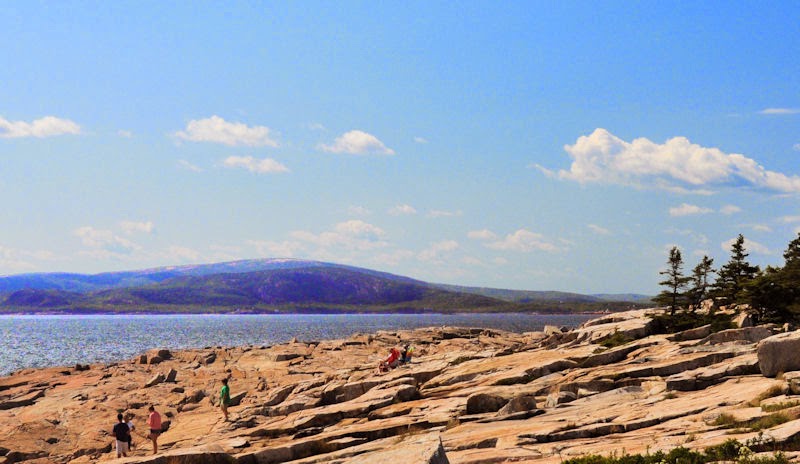
The coast is mostly granite rocks and covered with tourists.  It is nice to look at but not safe for entering or exiting the water.  There is one sand beach, conveniently labeled as "Sand Beach".  It is fairly popular but when we were there it was covered with decaying sea weed which significantly stunk up the place.  And we didn't see anyone swimming, the water at this latitude being in the mid-fifties.

Mighty Cadillac Mountain from the far side of the harbor
Because it is the only national park within a day's drive of most of the eastern cities, the locals flock to Acadia like maggots, filling every parking space and bus seat.  We wanted to take one of the famous carriage rides but they were booked for 4-5 days in advance and we ran out of time.  We did get a reservation for tea at the Jordan Pond House, but when we arrived there were no parking spaces within a mile of the place.  After cruising around the 2 parking lots for 40 minutes we finally gave up.  The park recommends you park at the visitor center and use the bus system but the buses only run every 30 min and they also fill up, leaving people stranded at the bus stop.

In fairness, there are obviously summer crowd problems at other parks but at someplace like Zion or Yellowstone we think the scenic payoff is better.  Our initial impression of Acadia is that it could be nice but in the current reality it is not worth the aggravation.

Oh, and as long as I am griping...


We drove to Ellsworth, the nearest town of any size, to see Guardians of the Galaxy.  It was a fun movie and deserves all the good press it has gotten.  But the theater in Ellsworth was a disaster.  It is set up in what appears to be previously unrented store space in a modest strip mall.  The screen was really too small for the room, not filling enough of the viewer's visual field to give a real theater experience.  In spite of that, they kept the projector under powered (which exhibitors do to try and lengthen the life of the projector bulb) so the picture was dim and murky.  Worst of all, it seemed like they were playing the 7 channel surround sound on only 2 channels, so the actors would fade in and out depending on where the character was standing in the shot.  We missed a good portion of the dialog.  I guess being located just outside a National Park, they figure they don't have to rely on repeat business.  Had we known, we would have driven the extra 20 miles to Bangor.


Last winter we spent three months working on the Navajo reservation in Arizona.  After a few months to sort through her feelings about it, Vicki has written up her impressions of the experience which we will be including in segments over the next few posts

We Be City Folks:  Working in Chinle
By Vicki Rains


Our vacant lot in Chinle
We spent 3 months, from mid-February to mid-May working in Chinle, Arizona at the Indian Health Center on the Navajo reservation.  For those of you who understand what workamping is, did the doctor form called Locum Tenens.  Because there is a doctor shortage, there are many companies out there trying to place doctors short term in places it is difficult to find doctors to commit to long term.  Yes, we are two of many doctors that retired early because we just couldn’t stand it anymore.  Placing medical personnel in temp positions has become big business.  Most of you have heard of traveling nurses.  Well they also place pharmacists, pharmacy techs, lab techs, etc.  When we visited the CompHealth facility near Salt Lake, it was very clear how successful the business is.  The building they were housed in was big, lovely, with a gorgeous view and they were going to be moving to a larger “campus” soon.
 

Just outside the motorhome door
So what does our title have to do with working in Chinle?  Well, Chinle and the Navajo reservation are really rural and there were some unexpected experiences that looking back are quite amusing, but at the time were a bit unsettling. Like the time when I was about to take the dogs out and looked out the window to find horses grazing 5 feet from the door.  Ziva, our 12 pound schnoodle, is an alpha female and she thinks she is tough.  She barks at any sized animal when she is on the leash, without regards to the consequences.  What would the horses do?  Fortunately due to the drought there wasn’t much to graze on in the gravel yard so the horses moved on quickly.
 

The neighbors
Then there was the time that I looked out and saw cattle grazing in the yard.  Now, I’ve been around horses before, though not ones that roamed freely, unbridled.  But I haven’t been close to cows and calves, except to look at them from a distance.  I needed to take the dogs out.  So what was I to do?  Again, there was little to graze on so they moved on.  Those of you who are not city folk are probably wondering what the problem is with having cattle and horses graze in your yard.  The answer is in the picture.
 

Benefits of free wandering livestock
Ah, the stray and feral dogs.  When we first arrived I was afraid of them, thinking they were all feral.  When I took my dogs out walking they stayed at least 50 feet away and just monitored us, despite the fact that Ziva barked at them when they came near.  Eventually we came to learn that 2 of the dogs were owned by someone just down the road.  One of those 2 dogs was a sheep herding dog and was the obvious leader of the dog pack.
 

Not a feral dog but a reasonable facsimile
I had to drive back to California just before Easter because it appeared that my dad was actively dying.  (He didn’t die then because his daughter came back, 2 of his 3 grandchildren visited and he was fed an ice cream diet, his favorite food, because he couldn’t swallow.)  Just before I came back to the reservation, Roger awoke one morning to find one of the young stray dogs was lying on our door mat with a gash in its forehead.  Roger had heard a ruckus between the horses and dogs the night before so he figured that a horse had kicked this poor canine.  He felt sorry for the pooch and didn’t think he was long for this world so he gave the dog what remained of the schnoodles dog food.  From that time on that dog (which did not die after all) adopted us.  Shortly thereafter when I returned to Chinle the dog was essentially living on our door mat and I was frightened when I had to take the dogs out.  However, that dog and the sheep herding dog accompanied us from then on during all of our dog walks and now their distance was only about 10 feet.  I think we were being herded.  They even allowed me to pet them.  Yes, I became fond of them and enjoyed our dog walking ritual.  Unfortunately, the hospital’s head of housing came by and asked Roger if the stray dogs were ours.  When he said, “No,” we think she called animal control because they disappeared the next day and we never saw them again.