Saturday, November 23, 2013

The Budget (by Vicki)

I just thought I would write on a couple of topics that Roger isn’t as interested in.  The first is Budgets.  We put ourselves on a budget for the first time in about 15 years.  For those last few years we were both busy physicians bringing in much more than we spent but we never had much free time.  This is what I think lead to our burn out with medicine.  It can demand all of you and we were trained long ago to give it.

Most discussions regarding full timing have found that it costs about the same to full time as it did living in a house.  We are the exception but that is because of our particular situation, living in a 6 bedroom house on 0.8 acres with a pool.  We worked too many hours so we needed a personal assistant to handle what we never had time to do.  We had a housekeeper, dog groomer, pool man, gardener, handy man, hairdresser, etc.  We still had a house payment.  We are now spending $3000 - $4000 less per month.

Many of the budgets posted on the internet are from people who must be quite thrifty in what they spend.  I am fascinated at how ingenious some RV’ers are at managing their money and have picked up some of their ideas.  I love the topic of RVing on a Budget on the Escapees Forum, rvnetwork.com.  Assuming we do get locum tenens positions for 3 months this winter we do not need to be that thrifty, however the recent recession where the value of some of our investments dropped precipitously has made us think twice about future spending.  Who knows if we will have enough money to cover the rest of our lives?  It depends on how long we live, how many more recessions occur, how much money we make doing temporary work, whether we develop serious health problems and how much our health care costs.  Currently health insurance is our greatest expense at $1500/mo. on COBRA.  COBRA ends at the end of November and then we have to go bare during December due to pre-existing medical problems.  Mine is migraines.  As a physician I certainly didn’t know that migraines qualify as a pre-existing medical condition.  Hypertension doesn’t, so I could have had my doctor just write that as the diagnosis for one of my medications.  Oh well, too late now.

The other thing related to the health budget is the cost of medications.  Our current health insurance covers medications with a copay.  However the only way we can get medications at 3 month intervals is through their pharmacy through the mail.  That doesn’t work well for us so we joined the Walgreens generic prescription benefit plan and pick the medications up every 3 months where ever we happen to be.  They have honored prescription from Roger everywhere we have tried so far.  We paid about $220 last month for 3 months worth of medications, which was about the same as the copays back when we were getting our prescriptions "paid for" by the insurance.

Back to the budget, our next biggest expense is campground fees.  Our budget calls for spending $25/night.  However, this has been very hard to achieve.  We discovered we don’t care much for boondocking (dry camping with no hookups).  One has to be very careful about conserving water.  I can’t do a load of laundry.  I need to use wipes rather than water to wash my hands.  Doing it for one night is OK, but I would just rather have water and electricity, and if we are staying a week, sewer hookups.  One way to reduce costs is to go to campgrounds that have weekly rates.  We stayed for a week at a campground near San Antonio for approximately $33/night, rather than the $42 one day rate.  Unfortunately the rates near big cities and in tourist areas are quite high.  The rate near Rapid City, SD increased by about $10/day this past summer compared to what we were paying when we stayed there in the fall of 2012.  This increase and more has occurred across the country, especially during the summer so we weren’t able to meet our budget of $25/night.  $30/night is probably a more reasonable goal.  Another way we decrease our campground fees is to stay in Escapees campgrounds.  They are somewhat out of the way, which we like because we are tired of being citified (traffic, noise, etc.).  Escapees is the third largest RV club in the country and has its own set of campgrounds, mostly in the southern part of the country with 1 in Oregon and 1 in Washington.  Their rates are generally just under $20/night.  They also offer discounts at parks throughout the country. 

There is a tendency for those RV’ers who have been full timers for, say, longer than 2 or 3 years, to stay more than a week or two as they travel.  Monthly rates are even better than weekly rates.  But we are in our first year so we still like to get out and travel.  That is referred to as "hitch itch".  The recruiting company shoulp pay our camping fees if we are able to get a locum tenens position for 3 months.  That will help us stay within our budget.

The next big item is fuel costs.  We are very fortunate this year because fuel costs have fallen as we travelled east and now south.  We started in California at $3.89/gallon and recently paid $2.89 in Texas.  We do most of our site seeing in the Subaru Forester. If I am driving the Forester, I drive at 50 to 60 mph and get about 27 miles/gallon.  Roger just hasn’t completely slowed down in retirement and he drives at about 62 mph.  As mentioned, I follow the Escapees forum and multiple discussions suggest that the best mileage is obtained between 55 to 60 mph.  We haven’t calculated our mpg on the RV, I guess because we don’t want to know.  Discussions on the Forum suggest mpg at the 7-8 range.  Roger says we spent $405 on gasoline last month.  We do follow the recommendation to travel about 200 miles at a time.  Then we’re supposed to stay a week, but I realized that we wouldn’t make it back to California by December if we traveled that slowly so we are staying about 3 nights each place at an Escapees park.

Next is food costs.  We aren’t very good at that.  In fact it belongs above fuel because we eat out a lot, probably about 4-5 times a week for either lunch or dinner.  We also tend to buy items that have some processing such as already made salad, cut up vegetables for soups, etc.  We do now have a food card for every major market chain in the parts of the country we have traveled.  That saves some money.  We no longer have a Costco card because we can’t buy anything in bulk as there is no room to store it and we don’t need any excess weight to carry.  That eats up the mpg.  Roger says we spent $395 on groceries last month and $934 eating out.

The next biggest expense is to Verizon for cell and internet service.  We were spending about $300/month for 4 cell phones and 12gigabytes of data per month.  We use the campground’s wifi whenever we can, but that is often very limited.  We found that just wasn’t enough so we increased the gigabytes to 20 per month and will be spending about $343/month.  The biggest use of the net is streaming video, which we can’t do much of, but there are times such as watching certain YouTube videos and occasional TV shows.

Roger and I had a lot of clothes so we haven’t needed any in the last 6 months.  We have clothes stored in SD so I don’t think we will need much in the next 6 months.  We did find that we had to buy shoes.  For some reason our feet are just bigger and some of our shoes didn’t fit anymore.  I know that when we lived in Hawaii with greater humidity our shoe size was larger so maybe that explains the change.

We aren’t spending much on sundries because I used to buy at Costco.  We had so much left over, like deodorant, shampoo, toothpaste and hairspray.  We took that with us.  We spent $646 on entertainment last month.  It’s not what you think.  We didn’t sign up for satellite TV or radio even though we are “wired” for both.  We aren’t watching any TV.  We do occasionally listen to our recorded music on CDs.  The money was for museum fees, an annual national parks pass, state park entrance fees, the Grand Ole Opry, etc.  It’s what we do in retirement.  We mostly travel and site see.  We probably buy about $200/mo. from Amazon.

So now back to the $934 spent on eating out.  I’ve decided that we qualify as foodies.  I know that Roger’s brother and wife are foodies but I hadn’t realized that we now also qualify.  If you Google “foodie” you come up with multiple similar definitions such as, “a person with a particular interest in food; a gourmet.” or Wikipedia says “Foodies are a distinct hobbyist group. Typical foodie interests and activities include the food industry, wineries and wine tasting, breweries and beer sampling, food science, following restaurant openings and closings and occasionally reopenings, food distribution, food fads, health and nutrition, cooking classes, culinary tourism, and restaurant management. A foodie might develop a particular interest in a specific item, such as the best egg cream or burrito…” 
Roger and I like to try the local microbreweries when we travel.  We find microbreweries have beer that tastes similar to the wonderful beer we drank when we were in Germany.  Roger loves smoking meats so we have been sampling the local fare in places we are traveling.  We recently sampled what Trip Advisor indicated was the best barbecue in San Antonio.  We also love Mexican food but I finally got Roger to understand that we are only safe trying it in the Southwest.  He learned that the hard way when we tried a Mexican restaurant in Kentucky.  We did find a good restaurant in Spearfish, SD.  We had good Mexican food in Livingston, TX, as expected.  When we eat out it is to sample the local food.  We now have eaten fried pickles, fried green tomatoes, crawfish, catfish, whitefish, Mississippi tamales, Texas tamales, beer cheese, Kentucky Bourbon, Mint Julips, Scotch Eggs, mustard greens, etc.  Often we have to try these more than once to see how they differ in different places.  So let us know if you agree that we are foodies.  Oh, and we also like to try Triple D (Diners, Drive-Ins and Dives) restaurants and those that Alton Brown found on his motorcycle trips.

Tuesday, November 19, 2013

Natchez

For years, everything I knew about Natchez I learned from James Garner.

    Natchez to New Orleans
    Livin' on jacks and queens
    Maverick is a legend of the West


The Rosalee Mansion
That's it, just a name in a TV Western theme song. I'm not sure I could have even told you what state it was in. I probably would have guessed Texas or Colorado, you know, some place out in the wild West. After all, the show was a western and the name sounds vaguely Mexicanish. (It's not. It was named after the local Indians by Frenchmen, who founded the town in the 18th century.)  Well, it turns out Natchez is in Mississippi. Who knew? In the early days of the Mississippi River trade it was an important landing point for goods coming down the river. The Delta area around Natchez was also where the cotton agricultural boom started. The stuff would not grow farther east until the farmers in southern Mississippi created some hybrids that were more tolerant. Then South Carolina and Alabama and Georgia became the cotton Kings. In the meantime, cotton grown with slave labor made many a fortune in the Delta and a lot of those wealthy planters chose to have
St. Mary's Basilica
managers work their slaves while they built their primary residences in Natchez. In the early 19th century Natchez had more millionaires per capita than any other city in America. And that's back when a million bucks was real money.


Early on in the Civil War, after Adm. Farragut took New Orleans, the city fathers in Natchez had the good sense to surrender without a fight, so many of those old mansions remain intact. People still live in a lot of them. Having seen our share of old houses in the last few months, we chose to just admire them from the outside. The city also has a very nice former Cathedral. After over 150 years of service, St. Mary's Basilica got demoted when the diocese put up a new Cathedral in Jackson in 1977.


The Natchez Trace - 444 miles of this.
Natchez is the southern terminus of the Natchez Trace, a trail that was originally blazed by bison traveling north to the salt licks in Tennessee. The Indians followed the buffalo trails and the Europeans followed the Indians and by the early 19th century the trail had been widened out into a wagon track and was the primary north-south road up the Mississippi (mostly north.. all you had to do was float a few logs to get south). After the invention of the steamboat made upstream river travel more practical, the Natchez trace became much less used and fell into disrepair except for short stretches that still functioned as local roads. One of the projects of the Civilian Conservation Corps in the 1930s was to build a parkway that more or less follows the course of the old Natchez Trace for 444 miles from Natchez to Nashville. It is a limited access road with no commercial traffic allowed and the speed limit is only 50 miles an hour the whole way. We had originally intended to drive the whole thing but after talking to some people who had actually done it, we decided it might get boring after the first 100 or 200 miles, so we took the US Highway 61 instead. Then from Natchez, we drove the parkway back north a ways just to get a feel for it.

Emerald Mound
The road is mostly forested but not nearly as dense and claustrophobic as the Edge of the Wilderness Road we talked about back in Minnesota. Periodically there are pullouts to see various creeks and bayous and other local sites. For example, we walked around the Emerald Mound, an old Indian temple site that now looks mostly like a big grassy hill. After a number of stops and about 70 miles of road, we turned around and went back to Natchez.


Old Country Store
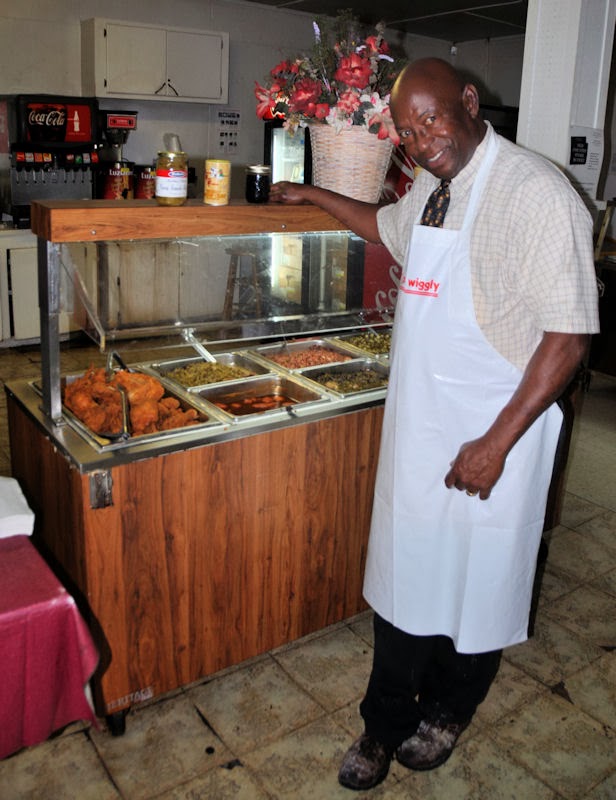
About 30 miles north of Natchez on Highway 61 is the tiny town of Lorman. By tiny I mean the visible extent of the town is only about four or five buildings. But one of those buildings is the Lorman Old Country Store which isn't really a general store anymore, it is a restaurant. Alton Brown visited the Old Country Store while filming "Feasting on Asphalt" several years ago and declared that they made, you guessed it, the best fried chicken on the planet. According to Alton "Whatever the voodoo is, that makes that chicken the way it is, I don't possess. It was like Colonel Sanders pole dancing. There was something real sexy going on with that chicken. I don't want to have any more chicken. I'm gonna have that chicken or no chicken at all, no fried chicken at all."

Dining room with the old store shelves still stocked
The restaurant is owned and operated by a gentleman named Arthur Davis who insists that everyone call him Mister D. The restaurant is actually an all-you-can-eat buffet. In addition to the fried chicken, which he makes daily by popular demand, there will also be, on any given day, a variety of other meats, side dishes and salads. I don't know that Mister D does all of the cooking but he is most certainly personally in charge of the kitchen. The day we were there he had ribs and sausages and some kind of chicken in a sauce that I bypassed in favor
Meet Mister D
of the fried stuff. In addition to managing all the food, Mister D strolls through the dining room about every 10 min. telling people to eat as much as they want. "Now yall bring yuh best appetite and don' feel sorry for the cook."  He also apparently frequently sings about biscuits but we did not get serenaded while we were there. The Lorman Old Country Store is open from 10 AM to 5 PM seven days per week. If you are anywhere within 100 miles of this place, make it a point to have a meal there and meet Mister D. I guarantee you will not regret it. Just be careful not to blink or you'll miss the whole town.

So this is now the fourth place that we have had "the best fried chicken on the planet". Which is really the best? Well, for my money it would be Gus's fried chicken in Memphis because they're chicken has just a touch of cayenne kick to it, but Mr. D would certainly run a very close second and at the Old Country Store I got spare ribs and some really superior coleslaw and potato salad as well, which puts them pretty much neck and neck. You won't go wrong either way.
Don't feel sorry for the cook.

Remains of the Windsor mansion
After we shook hands and parted from Mister D, we drove out and visited the ruins of the old Windsor mansion. This was a huge plantation house that survived the Civil War only to be reduced to ashes fifteen years later due to the careless disposal of a cigar. You see, it's true. Smoking is bad for you. Like many of the mansions of that era, the house had Corinthian columns but instead of just the front façade, they went all the way around the house supporting a completely circumferential balcony. Instead of making faux columns of wood, they made the columns out of brick and then covered them with plaster, the result being that after the rest of the house was gone, the columns remained giving the impression that you are visiting the ruins of an old Greek temple. The columns sit basically out in the middle of nowhere and it frankly astonishes me that they haven't suffered more vandalism over the past hundred years. They make for a pleasant 15 min. stroll and can give you some interesting photographs.

Kudzu
On the way out to the ruins we went through a fair amount of landscape that looks like this. Trees and bushes and fences all covered with what looks like ivy. This is kudzu, the shrub that ate the South. Throughout much of the southeastern United States this plant has been gradually taking over for 100 years. In ideal conditions, it can grow several centimeters a day and just covers everything. Competing plants eventually die for lack of sunlight. I first heard about kudzu when I was in college and knew that it was imported from Asia. What I did not know is that it was intentionally planted all over the South to help with soil conservation. Much of the current problem stems from tens of thousands of acres planted by Roosevelt's Civilian Conservation Corps. They didn't get everything right.

Tuesday, November 12, 2013

Vicksburg


Entering the Military Park
It was obvious to both sides early on in the Civil War that control of the Mississippi River was going to be essential. And controlling the Mississippi River largely meant controlling New Orleans and Vicksburg. The union was able to send the Navy in to take New Orleans in 1861 but Vicksburg was a somewhat tougher nut to crack. Several frontal assaults failed as the city was located at the top of several sets of bluffs and held superior position against any attackers. A hairpin turn in the Mississippi River right in front of the city gave the Confederate artillery lots of time to site in on any river traffic so the cannons on the heights could pretty easily blow apart any ships coming up or down the river. This problem was lessened by the production of ironclad gunboats specifically designed for river warfare. Then, in late 1862, the task of taking Vicksburg was given to a fiery young general named Ulysses S Grant.

The campaign for Vicksburg took over six months and is much too long a story to go through here, but the short (and not particularly accurate) version is that after throwing his troops against the Vicksburg fortifications
US Grant
a few times to no avail, Grant finally surrounded the city, cut off all of its supply lines and waited them out. The siege lasted for 47 days with daily pounding of the city from both gunboats and land-based artillery platforms. Grant was losing patience and had prepared for another all-out assault on July 6, but on July 4 Confederate Gen. Pemberton, realizing that no help was going to be forthcoming and with the city's population reduced to bidding for rats to put in the dinner pot, preempted Grant's attack and surrendered. On the previous day, Robert E Lee had suffered a significant setback in a little Pennsylvania town known as Gettysburg. The rest of the war would just be mop up operations.

Monuments
The Vicksburg Battlefield National Military Park is a 6 mile arc around the city where the two armies faced each other for six weeks. Civil War units were recruited locally from specific states and counties and each little patch of ground around Vicksburg was the responsibility of a specific unit from a specific area. After the war, every town in Indiana and Ohio and Illinois had to put up a monument to the bravery of their local boys. States put up bigger monuments and many individual families paid to plant some marble for their individual fallen heros. The result was that at one time there were over 1800 stone monuments at Vicksburg. Over the years, about a quarter of them have disappeared through theft, neglect and vandalism leaving around 1300 at this stage. That is a lot of monuments. When you take the driving tour, they seem pretty cool for the first couple miles. They become less interesting as you proceed and by the end of the tour you never want to see another piece of marble as long as you live. In between the monuments there is a lot of woodland and you can imagine soldiers crouching behind trees taking potshots at each other. But the fact is that every tree within a 10 mile radius had been stripped to make fortifications and to burn for fuel. In 1863 the two armies were facing each other across a completely barren wasteland.

In December of 1862, one of the Union's ironclad gunboats, the USS Cairo, patrolling the Yazoo River north of Vicksburg struck a mine and settled to the bottom where it was eventually covered in silt and thereby preserved. After a diligent search with metal detectors, the gunboat was rediscovered in 1956.
Remains of the USS Cairo
The plan was to raise the ship intact however the wooden hull was so soft that the cables they were trying to lift it with cut through the wood and the ship eventually had to be recovered in three sections. These were carefully restored and in the 1970s transported to the Vicksburg Military Park where the remains of the Cairo are currently displayed under a tensioned fabric covering to try and protect it from the miserable southern weather. During the recovery, they were able to salvage a (excuse the expression) boatload of artifacts, many of which are displayed in the associated USS Cairo Museum. The armor plating and cannon are very well preserved, the wooden parts of the structure less so and significantly deteriorating after being exposed for 40 years. It is certainly one of the most interesting parts of visiting the park.
A boatload of artifacts
While in Vicksburg we took the opportunity to eat at the world-famous Walnut Hills Restaurant (you know that they are world-famous because they tell you so right on their website) where they make the best fried chicken on the planet. This is actually the third place that we have eaten the best fried chicken on the planet. The first, you will recall, was at the Kurtz Restaurant in Bardstown Kentucky. In Memphis we ate at Gus's World-Famous Fried Chicken on Front Street which is also reputed to have the world's best. It was quite a bit spicier than the Bardstown chicken and I really liked it. Gus's is a real dive where they only do one thing, but they do it really well. If you don't want fried chicken, you gotta find another place to eat.

On the porch of the Walnut Hills Restaurant
The Walnut Hills restaurant is quite a bit more upscale. It is situated in a 100-year-old house in the downtown area where you sit at a nice table with a white tablecloth and choose from a relatively extensive menu. But if you are just passing through and are only going to eat there once, forget the menu, have the fried chicken. It is not as hot as Gus's but is well seasoned, juicy and delicious. The restaurant is supposed to be very busy in the evenings but we happened to be there in the midafternoon and essentially had the place to ourselves. If you're ever in Vicksburg, don't miss it.